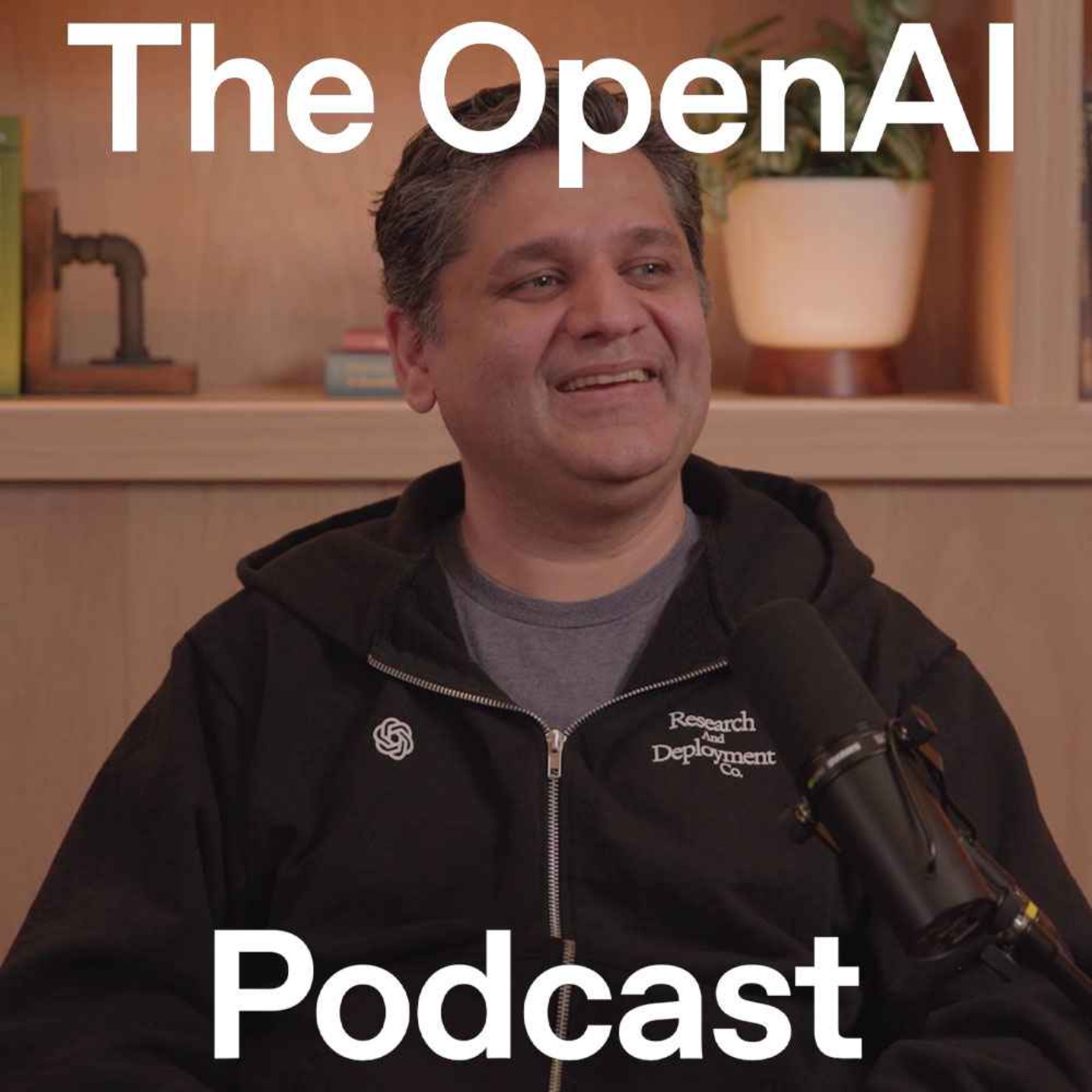
OpenAI Podcast · 2026-02-09
PodcastYouTubeOpenAI on Ads in ChatGPT: Trust, Transparency, and User Control
Hosts: Andrew Maine
Guests: Asad Awan
Why it matters
Ads are shown only to free and lower-tier users.
Key claims
- Ads are shown only to free and lower-tier users; pro, plus, and enterprise users experience no ads.
- Strict separation between AI model outputs and ads ensures trust and prevents model bias or collusion with ads.
- User conversations remain private; sensitive topics like health and politics are excluded from ad targeting.
- Users have transparency and control over what data is used for ad personalization, including options to clear data or disable personalization.
Radar summary
Summary
In this episode of the OpenAI Podcast, Asad Awan discusses the rationale and principles behind introducing ads in ChatGPT, particularly for free-tier users. OpenAI aims to democratize access to AI by using ads as a proven business model to support high usage limits for a large consumer base while maintaining a no-ads experience for paid subscribers and enterprise customers. The core focus is on preserving user trust by ensuring ads are clearly separated from AI-generated answers, maintaining privacy, and providing transparency and control over ad personalization and data usage.
The conversation highlights OpenAI's rigorous internal process for defining sensitive content where ads are excluded, and the high bar set for ad relevance and quality. OpenAI emphasizes that the model itself does not incorporate ads into its responses, preventing any collusion between ad content and AI outputs. Looking forward, OpenAI envisions more agentic and personalized ad experiences that simplify advertising for small businesses and help users discover niche products, all while upholding strict trust and privacy standards.
- Ads are shown only to free and lower-tier users; pro, plus, and enterprise users experience no ads.
- Strict separation between AI model outputs and ads ensures trust and prevents model bias or collusion with ads.
- User conversations remain private; sensitive topics like health and politics are excluded from ad targeting.
- Users have transparency and control over what data is used for ad personalization, including options to clear data or disable personalization.
- OpenAI prioritizes user trust above user value and ad revenue, aiming for high-quality, useful ads rather than maximizing ad impressions.
- Internal company culture and rigorous principles guide ad integration decisions, involving broad feedback and clear rubrics focused on trust.
- Future vision includes AI-powered ad agents that simplify advertising for small businesses and help users discover relevant niche products.
- OpenAI positions ads as a means to fund broad access to advanced AI capabilities, aligning with its mission to benefit all humanity.
Source material
Full source text
Hello, I'm Andrew Maine, and this is the opening iPodcast.
Today we're talking to a sod, a one about ads in chat GPT.
Have a look, who will see them, and how the company will preserve user trust.
Ads are shown to people who are on the free and the go-tia for pro and plus and for enterprise that are no ads.
It's creepy, okay, if it is good, it's not.
We are in the business of trust, so I think if we have to say, what is our core business is like to win users trust?
So, from a consumer point of view, why ads, why now?
It goes back to our mission, which is bringing age yet to all of humanity and to benefit all of humanity.
So, when you have a consumer product, which like, you know, 800 million plus people who are using this, then how do you take the best version of that product to everyone?
And ads is one of the most proven models to be able to do that for consumer products.
And I think the other part of that mission is how do you benefit all of humanity, which is like you want to take the best model.
You want to give the highest limits users limits to people.
You want to add for the ads to be actually helpful both to the users and the businesses as well.
So, I think it's a very natural fit for a company whose ambition is actually to take the best AI to all of all of humanity.
It's a very interesting decision because, on one hand, you could say, hey, we're going to take what we perceive as the high road and say, we're not going to do ads, but also we're not going to give a really good amount of usage for it and limit that and sort of maybe use not the most capable models, but sort of, you know, say, take that approach versus embracing it.
Yeah, yeah, I think if the goal is to truly democratize access, I think ads is a good model.
I think maybe what is hidden in that statement is, can ads be bad?
And the reality is, how do we think about the principles of ads?
How do we actually set a really high bar for what ads should be on this platform?
How do we make them actually useful?
So, when we were starting off, we thought, hey, what would be the core principles that we would announce to the world that would be proud of that we would stand behind and as a result, create a really great product.
So, just to give the example of the principles, it's like, number one, the answers need to be independent from the ads, both visually, but also in how the models are trained and how the system works, so that you can always trust the answer.
Like the whole product, jet-chargPD product is based on trust, so it actually needs to feed into that.
The second is your conversations are private.
If you have a sensitive conversation, that will never have ads in it and the conversation that never shared with that result.
So, while we do the matching between the best ad that can be a useful thing in a conversation that retizes don't get to see that, we do that matching internally.
And then, of course, like, you know, as you introduce ads, a big question is how did you know about this data?
What, like, that's a different between the user trust and just like doing something which is relevant to the user.
And our goal was how do we make something which users can transparently understand, how can they control and we can go into that, because I do think there is a high bar to shadow over there, because you could have some transparency some control with most products have, but what would be a really good version of that is something that we've been thinking about.
And finally, once you add ads, I think you have to set the incentives for the teams, for the company, in a way that actually continue to focus on user value.
So, you don't want to just like get empty-coloury time spent on the platform.
You want to build up a useful product and automatically, one good ad is good enough, actually.
So, we don't optimize for time spent on the platform and focus on the user.
So, these are the principles.
So, I think, like, so connecting this back to your question, is like, how do you why should we add ads and how to do it?
I think a part of that is take it to all of your vanity and that's the best business model to do that, but prevent all the negative things that can happen if you're not doing it thoughtfully and I think being upfront with our principles, being very clear with that is how we're starting and then how we will test how we will improve and how we become kind of a learning organization with this vector this, I think that's that's how so you said, basically, there's going to be a separation.
So, if I'm talking to chatchbt about, like, hey, I want to start drinking smoothies and stuff.
It's not going to all of a sudden blur it out.
Like, well, here's a blender you should buy.
Absolutely.
Yeah, it's an example.
Then in terms of what the model does to model doesn't know whether and I had this there or not, if you ask it, like, hey, what does this add saying?
It'll say, I actually don't know, but you can actually press the buttons and add it to the model if you want to add it.
So, it's totally totally separate.
Totally whatever is being displayed in the ad space, the model has no idea that's it.
That's right.
And I think in both visually, as well, so that the user can very quickly say, hey, this is the answer that I got from the model, and then the bottom banner, which has that in it, which is very clearly distinct.
So, visually, also you don't compute that.
Of course, we will learn how that experience involves, but the goal is to both keep the system, the models very, very separate and add this kind of downstream of.
Okay, yeah, that's I think that's a very important distinction because I think some people have sort of kind of tried to sort of spin that there's some sort of collusion between the ad part and the model part, but you're saying the models can fully separate.
Yeah.
So, it's interesting.
So, as I'm having a conversation, something might come up, and I can then click and say, okay, tell the model, hey, I saw this, then it knows what's going on.
That's right.
Yeah, you have to go, like in the four or six videos, you're explicitly have to press a button, there's like a chatGPD about this ad.
And that would be as if you took a link from the internet and asked a question about it.
So, it's almost the same.
We don't want to make that experience harder, but, but if you say, hey, what is this ad talking about?
It's easy to start now and say, oh, yeah, we're going to do the great thing.
We'll do it right.
But 10 years later, when there's an entire division in charge of ad revenue, might say, like, well, do we need the wall between the model and the ads?
Yeah.
Yeah, I think maybe there's multiple, multiple angles.
So, there's so one, we are in the business of trusting.
If you have to say, what is our core business?
It's like two end users trust and give amazing answers to the question that they're asking.
That's in the consumer product side.
And, of course, on the enterprise, I trusted everything, which is like you're interesting us with your most important data, we need to, of course, make it maintain that.
So, because I think that the ambition and the vision is so expansive, I think trust is the central point of it.
We want to have devices which are helpful for you.
If we truly want to be your best personal assistant, then you need to be able to share your most important information.
But no, that it will be dealt in a way, which is like how you would trade in yourself.
So, I think our business model is trust.
This is very different than many other scenarios.
If you're just doing like kind of a transactional stuff, like, again, you give the question and answer came back and that's the end of it, like a search query.
I think that's okay, but it is not a long-term relationship.
I think if you think of content discovery, certainly, I mean, like, it is just pushing things and trust is not a core component of that.
For us, I think the whole product, whether it's enterprise, whether it's consumer, whether it's anything devices in the future, they're all centered around trust.
So, for us, it's kind of imperative for others, it could be optional.
And I think different companies are known for different things and we do want to be known for trust.
And so, I think connecting this to the question, which is, there'll be drift.
I think you can't drift when the incentive is set up to be the best at this.
And this is the goal that we want to achieve.
Everything else is there to support that vision, but the Uber principle is trust.
Opening has a very huge number of people using the free tier.
And then there's also paid subscribers and people who do that and pro users, whatever.
How are ads going to play out across the platform?
Yeah, so ads are shown to people who are on the free and the go tier.
And for pro and plus and for enterprise, there are no ads.
And I think that's an important thing, like the context in which the company operates is actually like multiple missions, which come all together to bring air to everyone, which is when enterprise use it, that's a very specific context.
There is no ads over there.
It is a specific business model around that, which is very powerful for subscribers who want to like, you know, the best, like, you know, highest limits and very advanced features.
I think that also works.
But for a lot of people, a lot of consumers, the best way to do that is to have, have high limits and free usage.
And then ads, which are actually useful.
Yeah.
I've heard people talk about, you know, part of the goal of this is to avoid making the free tier just like the most limited thing available.
Absolutely.
I think that, that is the, that is the most I think frustrating things for a lot of real users.
It's just like you ask five questions and then it just stops in other businesses, right?
We, I think like we want to grow that a lot more and I think it fits with our overall goal.
That higher usage limits is better.
And how do we fund that and be practical about it?
So going a little behind the scenes, how are these decisions made like who's in the room talking about this?
Yeah.
I think this is a, this is a good opportunity also to talk a little bit about like overall, like there is a company culture and I think different companies are different culture, which results in different products.
And our, our company has like this DNA for research team, right?
So, so we have much more, I think, rigorous, device, rigorous understanding of how should we make these principles, how does incentives work, how does the model of this going to work in a way that it doesn't get corrupted later on?
So we have had a lot of debates on that, which actually resulted in these principles, which resulted in this rubric, which they hundreds of round tables with like folks around the company on different areas, not just like public working on ads, but everyone on every different part of the company giving feedback to create these principles.
Then we can convert those to a very simple rubric.
I think like the rubric is user trust is the most important thing.
User trust more than user value, which is then more important and does have value, which is more important than the amp in you.
And I think, well, this seems very straightforward.
It's actually a very, very, very, I think, in that decision.
So we can go into a little bit just like user trust more than user value.
A good example of that is if I showed you a really good ad, but and you liked it, you clicked on it, you bought something.
But later on, you asked the question, was this app listening to me and is the mic on?
That that's not user trust, you probably did provide some value.
So for us, our goal is like we cannot have that, the users need to believe and understand and control what's happening.
So that's just one example, but I think once you set that right rubric up, then even bottom up the team thinks like that.
But of course, like, you know, as we have different decisions, the different level, I think we have a pretty rigorous process on how we discussed privacy within the company, how we discussed safety within the company, and they're very, very clear forums for that.
And then of course, like as we as we make decision that leadership level, we want to go back to the simple rubric, because all those rubric is simple.
It's actually pretty pretty in depth.
And actually it's very discriminating if you think about these kind of questions.
It's like, should that be so good, but the users don't know where this data came from?
It's creepy.
Okay.
If it is good, it's not.
So I think maybe it follows from that.
What am I going to see on my end?
What kind of controls do I have?
Our house personalization in a work?
So I didn't like a big part of actually delivering really good ads is allow personalization.
So that is, so when I say, I want to go on a trip to your community and then that shows me camping gear, because that's what I like to do.
But of course, I think the flip side of that, how do you gain user trust?
Which is like, how do you know about this?
How do you learn about this?
So one is transparency aspect, which is like you can see what is the data that we have on you, which is being used for ads.
The second is the controls, which lets you see, say, which part of the data from your past ads can be used?
Of course, sensitive chats, those are never used.
But you can clear your data, which actually nobody else does, which is kind of a crazy concept.
Like you can clear your data.
So we don't know and we want to use that.
You could say, don't use my past chats.
If that's what you care about, or you could say, turn off personalization fully.
Of course, there is the other extreme, which is like, I don't want ads.
That's a form of control.
And that's where I think upgrading to the pro or plus version to completely stop ads is also there.
So I think all the way from this spectrum, I was like, I really care about this.
I don't think this is the right business model, like, pro and plus is the right business model.
For, like, hey, I don't know what we were talking about yesterday.
I'll just clear my history.
Great.
Do that.
Or it's like, hey, I'm more comfortable with, like, you know, clicks on the ads being used, but not my past conversations.
You could actually do that as well.
Of course, people will learn hopefully experience, like, how it improved their experience.
We have a very high bar in how we use these things.
But in the end, the users need to know and be able to to control that.
What will be, you know, the kind of the expectation for how many ads I'm going to see or how often this would come up.
Maybe the Uber principle still goes back to in that context is there a good ad to show, which is useful.
If it is not, we don't not show you anything.
In fact, like, you know, as we roll out this test, you'll see that there'll be very few ads because, like, you know, we want to be both conservative and we want to learn how to, where to insert those.
But, but the principle is a little bit more around it's useful.
It's helpful.
It doesn't add to what the user is doing and can be actually show a really good product as well.
So, keep the quality of the content very high as well.
Keep the quality of the ad very high as well.
Keep the balance very high.
If we can't find a good match, it's fine.
You don't need to show an ad.
You mentioned the sensitive conversations.
How do you know what something is sensitive or not?
So, that's actually one of one of the big strengths of opinion is, like, both for our organic work and a lot of research in the company has gone into defining what sensitive it is.
Health, politics, like, well, it's like many different kind of vertical.
Very, very in-depth definitions of that.
And then, of course, using some of the best models to actually predict and understand the conversation and saying, marking it as sensitive or not.
I think, like, I've actually never seen such high precision in any product so far, in my career, what we have been able to build over here by taking in those policies.
There's a team which works on defining those policies very, very rigorously.
And then, actually, also, sharing them with internal external partners for review, and then, of course, they're enforcement that comes from the prediction system that actually says, hey, like, this is matching this policy.
So, don't we?
We've talked a little bit about this, but I like to touch back on this again, design.
So, where is that going to head?
What are they going to look like?
As you were designing this product, I think, of course, we set up a very clear principle that the answers are separate from the model.
And then, the question was, like, how does that actually look in the product?
And on that spectrum, on one side, is, like, how do you make it look native so that it's not jarring?
And on the other side, there is a question which is, like, hey, how can it be very clearly separated out?
And I think you can debate with, on both of them, and there is values in both of them, and we start, we wanted to kind of set up the experiment in our way, which is that we can learn as we go.
So, we take the conservative option, and still keep that principle in mind.
And as we learn through building the product to getting the data evolve it.
But, but the idea still is, how can we maintain that principle of the answers being very clearly separated from the model from the ads, and having a very clear and sustainability and visual distinction?
I do think we will evolve the formats, and I think they will get even more useful and better over time.
But that principle is constant, and within the options that we had, we started with something which is clearly separated out in conservative.
So, you explain kind of a technical level, how there's this separation, how the model doesn't see it, but also for guardrails and stuff.
And I think you mentioned this before, but if I'm talking about, you know, saying, like, hey, I'm afraid of this trip, and it's like, well, hey, I've got some life insurance, you know, that's not going to happen, but how do you guys put in guardrails, and how do you decide what's our appropriate ads and what's not?
So, so maybe there's two questions in there, like, what's appropriate ads or not, and which context is a reasonable one?
And the second is, what are the controls in place, so that, like, you know, over time, this doesn't, this doesn't, I do know.
So, I think maybe a part of announcing our principles and being very clear internally for our rubric was to actually set that up in the first place.
Then automatically, a lot of the governance within the company, how we make decisions for all those from that onwards.
So, it's like, hey, I want to make this change to the product, do this fit with this principle, do the fit with this rubric that we have already set up.
That's the first pass.
I think the sensitive context is something that we take, very seriously, as well, very simple things, like, you know, conversation around health, politics or other context, where there ads don't fit, and that data is not going to be used for making ads, like, even matching ads, you just filter it out.
So, the first layer is really see does an ad belong here.
If it does, and it can be helpful and additive, then add it.
I think, like, this goes back to the principles, like, actually, you don't win neither for users, nor for businesses by showing many ads, because if you don't want, ad has to pay randomly for impressions, you don't want users to see too many ads, you want to share the one right ad and being one of, like, you know, the best AI company, I think that's hopefully something will do really well.
Every time we do an episode, we get a few people who go in the comments or, like, no ads, no ads, no ads.
Now is your chance to talk to those people directly?
Yeah, I think, in some sense, when people say no ads, I feel like there is a perception, and it's not wrong that, because I think, like, maybe how the industry is evolved, that there is some suspicion on how this works.
So, I do think it is kind of incumbent on us to come up with better principles, get a better clarity, better rules on how we're going to do this.
I think there is, like, like, again, this whole ad industry, if you think about the online ad industry, like, maybe 20 years old compared to many other industry, which are hundreds of years also.
So, I think maybe we are in the third inning of this, where we are saying, okay, we have learned from all of these questions and problems that people have.
I think when people say, no, as I do believe that they have valid questions and concerns around privacy, it's on us to do a really good job to earn their trust, through better transparency, through better control, through, through building that is also delightful.
I think there's still be skeptics, and then I think we have a way to upgrade, because I think that's a valid choice as well, but enabling really good ads, good principles.
I think it's possible, I think, a big part of it is having really strong AI to power these ads also, so that they're actually useful and then, as a result, bring this product to so many people without with higher limits.
Some of your competitors have been having a little bit of fun at the idea of ads.
Yeah, I think different countries have different missions.
The arm mission is to take AI to all of humanity, and of course, we have different contacts, so we have the enterprise business, we have our subscription business, and we have a very, very huge consumer business using our product.
So, I think within that context, we need to serve each one of them.
We will have a really robust enterprise business, and there will be no ads over there, and then we'll have a very robust consumer business, and ads will help us grow within that.
So, I think if that's not your mission, maybe it doesn't make sense, but our mission is to actually building all of these contacts, and we believe they're all actually related in how we build the best AI, and then actually take it to everyone.
And I think the good part is that we have different articles in the business line, so it's not just an ads company.
There are some companies which are purely just ads companies, and they're the incentives are actually different, but I think we have a much more holistic view on this.
And also, when you're not serving hundreds of millions of free users, it's easier to sort of say, yeah, we don't have to do this.
I don't think it's like a vision vision, which is, which is set in abstract.
This is truly a vision, which is like, how does AI actually help people?
And if there is like the latest view that some people get to use it, and some don't get to use it, based on who can pay, I think that itself is a pretty big fork in the road in terms of how AI can be valuable to people.
And I think our position is pretty, pretty much like everybody needs to have access to the best AI.
I have friends at small businesses, and they are always trying to figure out how to promote themselves and do that.
Did you explain from that point of view like what it's going to be like for people who are actually trying to reach new audience experience?
Yeah, I think that's such a good question.
Like usually, I have a few friends who started e-commerce company selling shoes, and they did almost everything on their own like the founders.
It's just like, go to the factory, get this done, get the logistics done.
But when it came to add, they actually have to add to hire like three performance marketers to do the work because it's so, so cumbersome, so analytical, if you don't do it right, you could end up wasting a lot of money.
So, I do think the vision has to be where almost as easy as you're prompting nowadays, who questions, you could say, buying goal is sell these shoes more in mid-west and go.
And then it comes back as like, hey, I tried some experiments, and I think this is the right bit given your price point.
This is the right way to think that do you want to spend more money on this.
And then you continue that conversation and almost become an agent for that.
But today, literally a small business has to hire performance marketers which could be one of the biggest costs, in some sense, actually like, you know, just that cost of running adds through through that is actually one of the biggest costs in that which of course then makes things more expensive.
So, I think the vision would be that it is as easy as just steering and telling what you need for on your business.
So, describing the what, but not having to think about how it will work and how many campaigns and how much dollars and everything else is like, hey, I want to spend this much, I want to grow my business as much, these are the constraints and adds a created and run to match your constraints and nonsense.
Yeah, it's a very interesting way to think about it because auctions were revolutionary.
The idea that you just go in there, I want to put this words out there and pay for that to do it.
But that created an entire ecosystem of all the sort of expertise and stuff that you have to do and it's really hard for small businesses to try to play in that space.
Yeah, I think as as the competition on that increase, I think like the people who had more time and money to spend on optimizing that and analyzing the data and then running the best possible ad got the benefit from that versus like if I didn't know that like, hey, actually, I think I gave an example of an actual brand which is all birds it competed with really big brands on shoes.
But somehow they found that every designer in the tech company is going to love my shoe and finding that niche and then actually being able to create your creatives, if you're message to focus on that made them win in this like if you go in Silicon Valley, you'll see all birds up everywhere because of that.
So I think like, but that I think is not accessible to everyone if you're very analytical and you have a whole team of people who think about that, you could do that.
But theoretically, the best products can come to life if we can find out where the right niche distribution for it is and really go for that.
I think another story on this is like that there is this company which creates a vegan Ram instant ramen which I love because I don't have to feel bad about eating it.
But it's such a weird concept of vegan instant ramen like if I was just thinking about it without knowing about this company, I like this can't exist.
Who will want this?
But I think a really good product can help you find and discover those niche audience then you build a really good product.
So I think enriches everyone's life from that perspective but enabling creation of those products, selling of those products, maybe it's not the most of the billion dollar company but that's great.
That's still it's like a really big SMB which is growing and it's sort of these people who care about that very specific problem.
So I think it really enriches people life if you are able to create products for these niche.
What does this look like in the future where we're using things in a more agentic way, how are you even work 10 years from now?
I think a next step would be more actual conversation that way.
You could truly kind of understand what this product is about.
The next version would be kind of what behind the scenes and actually aggregate the best discounts and best deals and the best version of the product.
For example, if I know that I like Ramon and let's say some of our charity has understood that preference of mine then it could find that for me.
I didn't even know that that product exists is then in the behind the scenes it could actually say oh actually I found as we can now maybe that's something that's valuable and of course there is a marketplace where somebody could say hey we help people who are like this to discover because discovery goes from both directions like of course I'm searching for something and then people want me to discover something and there is a match between those.
So I think it will be more agentic but in the future but at least the current modality that thing we start from there improve it and make it relevant, make it controllable, understandable, trustworthy and as I think the systems evolve the native organic products evolve this will evolve as well with that.
Excellent well so I think if you're explaining this and look forward to seeing what's going to happen next.
Awesome thanks for having me.