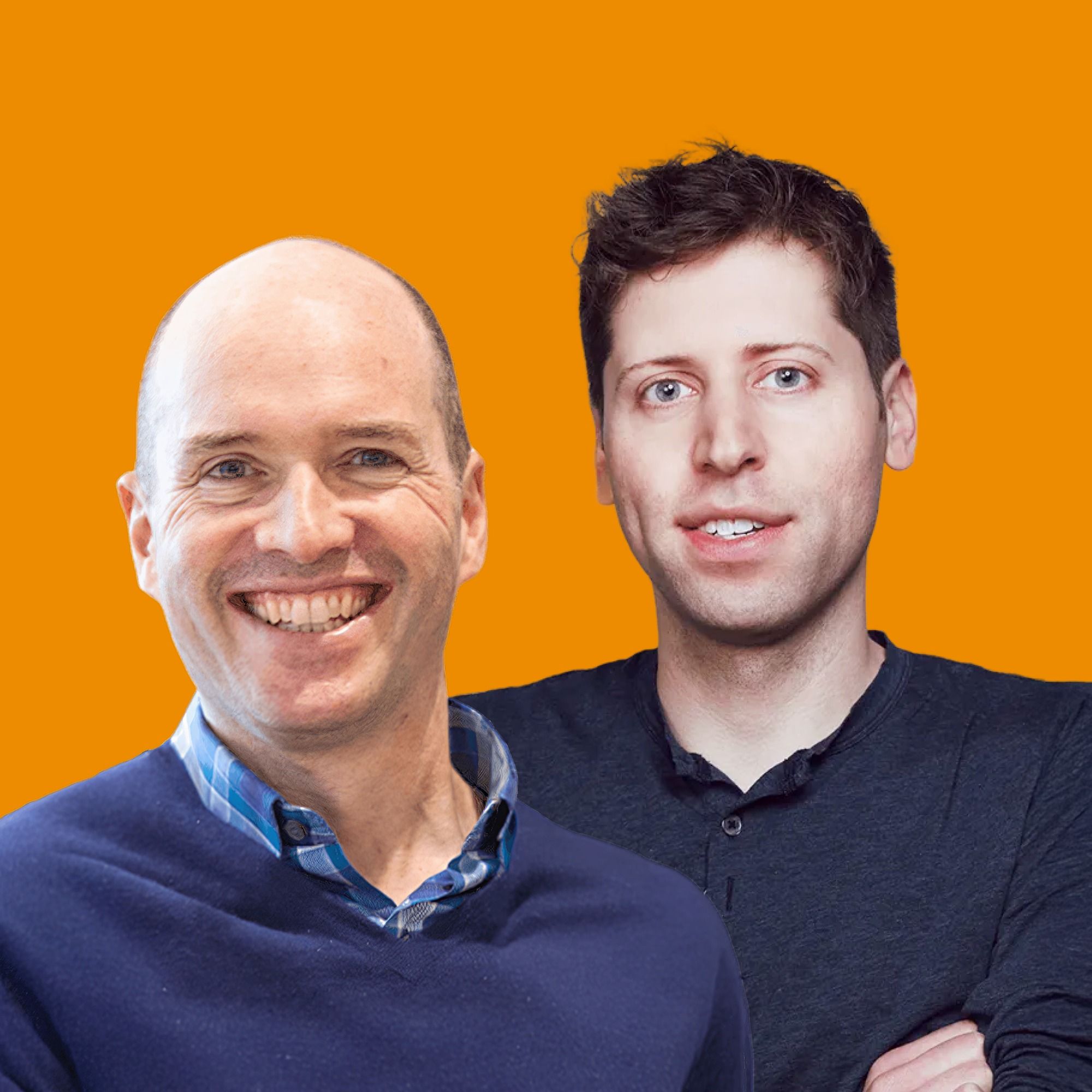
The a16z Show · 2025-10-08
PodcastYouTubeSam Altman on Sora, Energy, and Building an AI Empire
Hosts: Ben Horowitz
Guests: Sam Altman
Why it matters
Sora is positioned as strategically important to AGI via world models, not just a consumer product.
Key claims
- OpenAI is pursuing vertical integration across research, products, and infrastructure to deliver a 'personal AI' subscription, with compute partnerships announced with AMD, NVIDIA, and Oracle.
- Sora is positioned as strategically important to AGI via world models, not just a consumer product; Altman said video generation helps society 'co-evolve' with the technology.
- Altman predicted models will be 'doing bigger chunks of science' within two years, citing GPT-5 examples of novel math and physics discoveries as a personal Turing-test equivalent.
- Research receives GPU priority over product features; OpenAI is 'building the biggest data center in the history of humankind' to avoid painful trade-offs.
Radar summary
Summary
In a wide-ranging conversation with a16z's Ben Horowitz, OpenAI CEO Sam Altman framed the company as a vertically integrated stack spanning research, consumer products, and infrastructure, all aimed at building a 'personal AI' subscription that 'gets to know you.' He acknowledged having once opposed vertical integration but said the scale of what OpenAI is now building—described as 'the biggest data center in the history of humankind'—requires doing things in-house. He touted major compute partnerships with AMD, NVIDIA, and Oracle, calling the current moment 'time to go make a very aggressive infrastructure bet' driven by confidence in the research roadmap.
Altman devoted significant attention to Sora, arguing that world models will be more important to AGI than people realize and that shipping the product helps 'society co-evolve' with capabilities like realistic video generation. He flagged Sora's social networking features and the surprise that 'more people want to create content' than the traditional 1% creator assumption, which is forcing OpenAI to rethink monetization. Looking ahead, he predicted that within two years models will be 'doing bigger chunks of science,' citing GPT-5's emerging ability to make novel math and physics discoveries as the equivalent of the Turing test moment for him personally.
On policy and strategy, Altman argued against broad AI regulation, favoring scrutiny only of 'truly superhuman' models, and warned that US over-regulation while China advances would be 'extremely dangerous.' He expressed concern about universities adopting Chinese open-source models and praised the reception of GPT-OSS. On copyright, he predicted courts will treat training as fair use but develop new frameworks for generated content, noting some rights holders may actually want their characters used more. He also discussed the deep linkage between AI and energy, calling the prior Western rejection of nuclear 'incredibly dumb' and predicting solar-plus-storage and nuclear will dominate long-term energy supply.
Altman closed with reflections on ChatGPT's 800 million weekly active users, the 'capability overhang' most of the world doesn't see, and his belief that AGI's arrival will be more continuous and less disruptive than feared. He said research consistently gets GPU priority over product features, addressed ChatGPT's 'obsequiousness' as a solvable personalization problem, and warned that breaking user trust with ads could be catastrophic. On future trillion-dollar companies, he admitted deep humility and urged founders to 'be deeply in the trenches' rather than pattern-match off OpenAI itself.
- OpenAI is pursuing vertical integration across research, products, and infrastructure to deliver a 'personal AI' subscription, with compute partnerships announced with AMD, NVIDIA, and Oracle.
- Sora is positioned as strategically important to AGI via world models, not just a consumer product; Altman said video generation helps society 'co-evolve' with the technology.
- Altman predicted models will be 'doing bigger chunks of science' within two years, citing GPT-5 examples of novel math and physics discoveries as a personal Turing-test equivalent.
- Research receives GPU priority over product features; OpenAI is 'building the biggest data center in the history of humankind' to avoid painful trade-offs.
- On regulation, Altman wants scrutiny focused only on truly superhuman models and warned that US over-regulation while China advances would be 'extremely dangerous'.
- On open source, Altman praised GPT-OSS adoption but voiced concern about DeepSeek dominating in universities and 'relinquishing control of interpretation' to actors potentially influenced by the Chinese government.
- On copyright, Altman predicted training will be deemed fair use while new models emerge for generating content 'in the style of' rights holders; some IP owners may actually want more use of their characters.
- Altman linked AI and energy directly, calling the West's rejection of nuclear 'incredibly dumb' and forecasting solar-plus-storage and nuclear as the dominant long-term sources alongside near-term natural gas.
Source material
Full source text
Sort of thought we had stumbled on this one giant secret that we had these scaling laws for language models.
And that felt like such an incredible triumph.
I was like, 'We're probably never going to get that lucky again.
And deep learning has been this miracle that keeps on giving.
And we have kept finding breakthrough after breakthrough.'
Again, when we got the reasoning model breakthrough, I also thought that was like, 'We're never going to get another one like that.'
And it just seems so improbable that this one technology works so well.
But maybe this is always what it feels like when you discover like one of the big, you know, scientific breakthroughs is if it's like really big, it's pretty fundamental.
And it just, it keeps working.
OpenAI isn't just building an app.
It's building the biggest data center in human history.
Yesterday, I sat down with Ben Horowitz and Sam Altman, CEO of OpenAI.
We talk about OpenAI's vision to become the people's personal AI, the massive infrastructure behind it, and how the company's research is pushing toward AGI, including AI that can do real science.
We also talk about how his views have changed on open source, regulation, and why AI and energy are now deeply linked.
Let's get into it.
Sam, welcome to the A's and Z podcast.
Thanks for having me.
You've described in another interview, you've described OpenAI as a competition for companies.
Consumer technology business, a mega scale infrastructure operation, a research lab, and all the new stuff, including planned hardware devices.
From hardware to app integrations, job marketplace to commerce, what do all these bets add up to?
What's OpenAI's vision?
Yeah, I mean, maybe you should count it as three, maybe as four for kind of our own version of what traditionally would have been the research lab at this scale, but three core ones.
We want to be people's personal AI subscription.
I think most people have one, some people have several, and you'll use it in some first party consumer stuff with us, but you'll also log into a bunch of other services, and you'll just use it from dedicated devices at some point.
You'll have this AI that gets to know you and be really useful to you, and that's what we want to do.
It turns out that to support that, we also have to build out this massive amount of infrastructure, but the goal there, the mission is really like build this AGI and make it very useful to people.
And does the infrastructure, do you think it will end up, yeah, it's necessary for the main goal, will it also separately end up being another business, or is it just really going to be in service to the personal AI or unknown?
You mean like when we sell it to other companies as well as infrastructure?
Yeah, when you sell it to other companies, you know, it's such a massive thing, we have to do something else.
It feels to me like there will emerge some other thing to do like that, but I don't know, we don't have a current way to do it.
It's currently just meant to like support the service we want to deliver and the research.
Yeah, no, that makes sense.
The scale is sort of like terrifying enough that you've got to be open to doing something else.
Yeah, if you're building the biggest data center in the history of humankind.
The biggest infrastructure project.
There was a great interview you did many years ago in Strictly, VC, early Open App, well before chat GPT, and they're asking what's the business model, and you said, "Oh, we'll ask AI, it'll figure it out for us."
Everybody laughs.
There have been multiple times, and there was just another one recently where we have asked a then current model for what should we do, and it has had an insightful answer we missed.
I think when we say stuff like that, people don't take us seriously or literally.
But maybe the answer is you should take us both.
Yeah, well, no, as somebody who runs an organization, I ask the AI a lot of questions about what I should do.
It comes up with some pretty interesting answers.
Sometimes.
You have to give it enough context.
What is the thesis that connects these bets beyond more distribution, more compute?
I mean, the research enables us to make the great products, and the infrastructure enables us to do the research.
So it is kind of like a vertical stack of things.
Like you can use chatbt or some other service to get advice about what you should do running an organization, but for that to work, it requires great research and requires a lot of infrastructure.
So it is kind of just this one thing.
And do you think that there will be a point where that becomes completely horizontal, or will it stay vertically integrated for the foreseeable future?
I was always against vertical integration, and I now think I was just wrong about that.
Yeah, interesting.
Because you would like to think that the economy is efficient and the theory that companies can do one thing and then it is supposed to work.
I would like to think that.
And in our case, at least, it has not really...
I mean, it has in some ways, for sure.
In video, it makes an amazing chip or whatever that a lot of people can use.
But the story of Open AI has certainly been towards we have to do more things than we thought to be able to deliver on the mission.
Although the history of the computing industry has been a story of a back and forth in that there was the Wang word processor, and then the personal computer and the Blackberry before the smartphone.
So there has been this vertical integration and then not, but then the iPhone is also vertically integrated.
The iPhone, I think, is the most incredible product the tech industry has ever produced, and it is extraordinarily vertically integrated.
Amazingly so, yeah.
Interesting.
Which bets would you say are enablers of AGI versus which are hedges against uncertainty?
You could say that on the surface, Sora, for example, does not look like it is AGI relevant, but...
I would bet that if we can build really great world models, that will be much more important to AGI than people think.
There were a lot of people who thought chat GBT was not a very AGI relevant thing.
It has been very helpful to us, not only in building better models and understanding how society wants to use this, but also in bringing society along to actually figure out, "Man, we got to contend with this thing now."
For a long time before chat GBT, we would talk about AGI, and people were like, "This is not happening.
We don't care."
Then all of a sudden, they really cared.
And I think that research benefits aside, I'm a big believer that society and technology have to co-evolve.
It can't just drop the thing at the end.
It doesn't work that way.
It is ongoing back and forth.
Yeah.
Say more about how Sora fits into your strategy, because there is some hullabaloo on X around, "Hey, why devote precious GPUs to Sora?"
But is it a short-term, long-term trade-off?
Or are we so AGI?
Well, and then the new one had very interesting twists with the social networking.
Be very interested in how you're thinking about that, and did Meta call you up and get mad?
Or what do you expect the reaction to be?
I think if one company of the two of us feels more like the other one that's gone after them, it wouldn't.
If they shouldn't be calling us.
Well, I do know the history.
But first of all, I think it's cool to make great products, and people love the new Sora.
And I also think it is important to give society a taste of what's coming on this co-evolution point.
So very soon, the world is going to have to contend with incredible video models that can deep-fake anyone or show anything you want.
That will mostly be great.
There will be some adjustment that society has to go through.
And just like with chat GPT, we were like, "The world kind of needs to understand where this is."
I think it's very important the world understands where video is going very quickly, because video has much more emotional resonance than text.
And very soon, we're going to be in a world where this is going to be everywhere.
So I think there's something there.
As I mentioned, I think this will help our research program and is on the AGI path.
But it can't all be about just making people ruthlessly efficient and the AI solving all our problems.
There's got to be some fun and joy and delight along the way.
But we won't throw tons of compute out of it.
Or not by a fraction of our compute.
It's tons in the absolute sense, but not in the relative sense.
I want to talk about the future of AI/human interfaces, because back in August, you said the models have already saturated the chat use case.
So what do future AI/human interfaces look like, both in terms of hardware and software?
Is it a vision for a WeChat?
So solving the chat thing in a very narrow sense, which is if you're trying to have the most basic kind of chat-style conversation, it's very good.
But what a chat interface can do for you, it's nowhere near saturated.
Because you could ask a chat interface, "Please cure cancer."
Models certainly can't do that yet.
So I think the text interface style can go very far, even if for the chit chat use case, the models are already very good.
But of course there's better interfaces to have.
Actually, it's another thing that I think is cool about Sora.
You can imagine a world where the interface is just constantly real-time rendered video.
And what that would enable, and that's pretty cool.
You can imagine new kinds of hardware devices that are always ambiently aware of what's going on.
Rather than your phone blasting you with text message notifications whenever it wants, it really understands your context and when to show you what.
There's a long way to go on all that stuff.
Within the next couple of years, what will models be able to do that they're not able to do today?
It will be sort of white collar replacement at a much deeper level, AI scientist, humanoids.
I mean, a lot of things, but you touched on the one that I am most excited about, which is the AI scientist.
This is crazy that we're sitting here seriously talking about this.
I know there's like a quibble on what the Turing test literally is, but the popular conception of the Turing test sort of went whooshing by.
Yeah, that was fast.
You know, it was just like we talked about it as the most important test of AI for a long time.
It seemed impossibly far away.
Then all of a sudden it was passed.
The world freaked out for like a week, two weeks.
And then it's like, all right, I guess computers can do that now.
And everything just went on.
And I think that's happening again with science.
My own personal equivalent of the Turing test has always been when I can do science.
Like that is a real change to the world.
And for the first time with GPT-5, we are seeing these little examples where it's happening.
You see these things on Twitter.
It made this novel math discovery and did this small thing in my physics research, my biology research.
And everything we see is that that's going to go much further.
So in two years, I think the models will be doing bigger chunks of science and making important discoveries.
And that is a crazy thing.
Like that will have a significant impact on the world.
I am a believer that to a first order, scientific progress is what makes the world better over time.
And if we're about to have a lot more of that, that's a big change.
It's interesting because that's a positive change that people don't talk about.
It's gotten so much into the realm of the negative changes if AI gets extremely smart.
But carried out by disease.
It's like you could use a lot more science.
That's a really good point.
I think Alan Turing said this.
Somebody asked him, they said, "Well, you really think the computer is going to be smarter than the brilliant minds?"
He said, "It doesn't have to be smarter than a brilliant mind, just smarter than a mediocre mind like the president of AT&T."
And we should use more of that too, probably.
We just saw a periodic launch last week with OpenAI logs.
And to that point, it's amazing to see both the innovation that you guys are doing, but also the teams that come out of OpenAI just feels like are creating tremendous, capable things.
We certainly hope so.
I want to ask you about just broader reflections in terms of what sort of about diffusion or development in 2025 has surprised you?
Or what has sort of updated your worldview since chat day came out?
A lot of things again, but maybe the most interesting one is how much new stuff we found.
Sort of thought we had stumbled on this one giant secret that we had these scaling laws for language models.
And that felt like such an incredible triumph that I was like, we're probably never going to get that lucky again.
And deep learning has been this miracle that keeps on giving.
And we have kept finding breakthrough after breakthrough.
Again, when we got the reasoning model breakthrough, I also thought that was like, we're never going to get another one like that.
It just seems so improbable that this one technology works so well.
But maybe this is always what it feels like when you discover one of the big scientific breakthroughs.
If it's like really big, it's pretty fundamental and it just keeps working.
But the amount of progress, if you went back and used GPT 3.5 from chat GPT launch, you'd be like, I cannot believe anyone used this thing.
And now we're in this world where the capability overhang is so immense.
Like most of the world still just thinks about what chat GPT can do.
And then you have some nerds in Silicon Valley that are using codecs and they're like, wow, those people have no idea what's going on.
And then you have a few scientists who say this people using codecs have no idea what's going on.
But the overhang of capability is so big now.
And we've just come so far on what the models can do.
And in terms of further development, how far can we get with LLMs?
At what point do we need a new architecture?
How do you think about what breakthroughs are needed?
I think far enough that we can make something that we'll figure out the next breakthrough with the current technology.
Like it's a very self-referential answer, but if LLM based stuff can get far enough that it can do like better research than all of opening up put together, maybe that's like good enough.
Yeah, that would be a big breakthrough.
A very big breakthrough.
So on the more mundane, one of the things that people have kind of started to complain about, I think South Park did a whole episode on it, is kind of the obsequiousness.
Of kind of AI and chat GPT in particular.
And how hard a problem is that to deal with?
Is it not that hard or is it like kind of a fundamentally hard problem?
Oh, it's not at all hard to deal with.
A lot of users really want it.
Yeah.
If you go look at what people say about chat GPT online, there's a lot of people who like really want that back.
So it's not technically it's not hard to deal with at all.
One thing, and this is not surprising in any way, but the incredibly wide distribution of what users want.
Yeah.
Like how they'd like a chatbot to behave in big and small ways.
Does that, did you end up having to configure the personality then you think?
Is that going to be the answer?
I think so.
I mean, ideally you just talk to chat GPT for a little while and it kind of interviews you and also sort of sees what you like and don't like.
And chat GPT just figures it out.
But in the short term, you'll probably just pick one.
Got it.
And that makes sense.
Very interesting.
And actually, so one thing I wanted to ask you about is, yeah.
Like I think we just had a really naive thing, which, you know, like it would sort of be unusual to think you could make something that would talk to billions of people and everybody wants to talk to the same person.
Yeah.
Yeah.
And it's a more implicit assumption for a long time.
Right.
Because people have very different friends.
People have very different friends.
Yeah.
So now we're trying to fix that.
Yeah.
And also kind of different friends, different interests, different levels of intellectual capability.
So you don't really want to be talking to the same thing all the time.
And one of the great things about it is you can say, well, explain it to me like I'm five.
But maybe I don't even want to have to do that front.
Yeah.
I always want you to talk to me like I'm five.
It should just learn that.
Yeah.
Particularly for teaching me stuff.
I want to ask you a kind of like a CEO question, which has been interesting for me to observe you is you just did this deal with AMD and, you know, of course, the company's in a different position and you have more leverage in these kinds of things.
But like, how has your kind of thinking changed over the years since you did that initial deal at all?
I had very little operating experience then.
I had very little experience running.
I am not naturally someone to run a company.
I'm a great fit to be an investor.
Yeah.
I thought that was going to be, that was what I did before this.
And I thought that was going to be my career.
Yeah.
Although you were a CEO before that.
Not a good one.
And so I think I had the mindset of like an investor advising a company.
Interesting.
Right.
Now I understand what it's like to actually have to run a company.
Yeah.
Right.
Right.
There's more.
I've learned a lot about how to, you know, like what it takes to operationalize deals over time.
Right.
All the implications of the agreement as opposed to just, oh, we're going to get distribution money.
That makes sense.
You know, cause I just, I was very impressed at a deal structure improvement.
More broadly in the last few weeks alone, you mentioned AMD, but also Oracle, Nvidia, you've chosen to strike these deals and partnerships with companies that you collaborate with, but could also potentially compete with in certain areas.
How do you decide, you know, when to collaborate versus when not to, or how do you just think about?
We have decided that it is time to go make a very aggressive infrastructure bet.
And we're like, I've never been more confident in the research roadmap in front of us and also the economic value that will come from using those models.
But to make the bet at this scale, we kind of need the whole industry to, or a big chunk of the industry to support it.
And this is like, you know, from the level of like electrons to model distribution and all the stuff in between, which is a lot.
And so we're going to partner with a lot of people.
You should expect like much more from us in the coming months.
Actually expand on that.
Cause when you talk about the scale, it does feel like in your mind, the limit on it is unlimited.
Like you would scale it as, you know, as big as you possibly could.
There's totally a limit.
Like there's some amount of global GDP.
Yeah.
And you know, there's some traction of it that is knowledge work and we don't do robots yet.
Yes.
But the limits are out there.
It feels like the limits are very far from where we are today.
If we are right about, so I shouldn't say from where we are, like if we are right that the model capability is going to go where we think it's going to go, then the economic value that sits there can go very, very far.
Right.
So you wouldn't do it.
Like if all you ever had was today's model, you wouldn't go there.
No, definitely not.
So it's a combination.
I mean, we would still expand because we can see how much demand there is.
We can't serve with today's model, but we would not be going this aggressive if all we had was today's model.
Right.
Right.
We get to see a year or two in advance though.
Yeah.
Interesting.
So, Chagifus, 800 million weekly active users, about 10% of the world's population, fastest growing consumer product ever, it seems.
How do...
Faster than anyone I ever saw.
How do you balance optimizing for active users at the same time being a product company and a research company?
How do you throw the news?
When there's a constraint, which happens all the time, we almost always prioritize giving the GPUs to research over supporting the product.
Part of the reason we run Build This Capacity so we don't have to make such painful decisions, there are weaker times, like a new feature launches and it's going really viral or whatever where research will temporarily sacrifice some GPUs.
But on the whole, we're here to build AGI and research gets the priority.
Yeah.
You said in your interview with your brother Jack around how other companies can try to imitate the products or buy your...
Buy our IP, maybe.
Yeah.
All sorts of things.
But they can't buy the culture.
The sort of repeatable sort of machine, if you will, that is constantly...
The culture of innovation.
How have you done that?
What are you doing?
Talk about this culture of innovation.
This was one thing that I think was very useful about coming from an investor background.
A really good research culture looks much more like running a really good seed stage investing firm and betting on founders and sort of that kind of...
Then it does like running a product company.
So I think having that experience was really helpful to the culture we built.
Yeah.
Yeah.
That's sort of how I see...
Benetty sees in some ways, which we...
Your CEO will also have his portfolio and have an investor mindset.
Right.
He's a CEO going to investor.
He's an investor going to CEO.
It is unusual in this direction.
Yeah.
Yeah.
Well, it never works.
You're the only one who I think I've seen go that way and have it work.
Workday was like that, right?
Oh, but Anil was...
He was an operator before he was an investor.
And I mean, he was really an operator.
People's office was pretty big.
And why is it?
Because for investors, they don't want to operate him.
No, I think that investors...
Generally if you're good at investing, you're not necessarily good at like organizational dynamics, conflict resolution, just like the deep psychology of like all the weird shit and then how politics get created.
There's just like all this...
the detailed work in being an operator or being a CEO is so vast and it's not as intellectually stimulating.
It's not something you can ever go talk to somebody at a cocktail party about.
And so like you're an investor, you get like, "Oh, everybody thinks I'm so smart."
Because you know everything.
You see all the companies and so forth.
And that's a good feeling.
And then being CEO is often a bad feeling.
And so it's really hard to go to a good feeling to a bad feeling.
I would just say...
I'm shocked by how different they are and I'm shocked by how much the difference between a good job and a bad job they are.
Yeah, yes.
Yeah, it's tough.
It's rough.
I mean, I can't even believe I'm running the firm.
I know better.
And he can't believe he's running OpenAI.
He knows better.
Going back to progress today, are you feeling still useful in a world in which they're getting saturated, gained?
Are they still the...
What is the best way to gauge model capability now?
Well, we're talking about scientific discovery.
I think that'll be an eval that can go for a long time.
Revenue is kind of an interesting one.
But I think the static evals of benchmark scores are less interesting.
And also those are crazily gained.
More broadly it seems like...
That's all there is, as far as I can tell you.
More broadly it seems that the culture, Twitter, is less AGI-pilled than it was a year or so ago when the AI2027 thing came out.
Some people point to GPT-5, them not seeing sort of the obvious...
Obviously, there are a lot of progress that in some ways under the surface are not as obvious to what people are expecting.
But should people be less AGI-pilled or is this just Twitter vibes?
Well, a little bit of both.
I think like we talked about the Turing test, AGI will come.
It will go whoosh and bye.
The world will not change as much as the impossible amount that you would think it should.
AGI would just be...
It won't actually be the singularity.
It will not.
Even if it's like doing kind of crazy AI research, like society will learn faster.
But one of the kind of like retrospective observations is people and society's all are just so much more adaptable than we think.
It was like a big update to think that AGI was going to come, you kind of go through that.
You need something new to think about, you make peace with that.
It turns out like it will be more continuous than we thought.
Which is good.
Which is really good.
I'm not up for the big bang.
Yeah.
Well, to that end, how have you sort of evolved your thinking, you mentioned you've all been thinking on sort of vertical integration.
How have you evolved your thinker?
What's the latest thinking on sort of AI stewardship, safety?
What's the latest thinking on that?
I do still think there are going to be some really strange or scary moments.
The fact that like so far the technology has not produced a really scary giant risk doesn't mean it never will.
But also, we're talking about it's kind of weird to have like billions of people talking to the same brain.
There may be these weird societal scale things that are already happening.
We that aren't scary in the big way, but are just sort of different.
But I expect like, I expect some really bad stuff to happen because of the technology, which also has happened with previous technologies and funding.
All the way back to fire.
Yeah.
And I think we'll like develop some guardrails around it as a society.
Yeah.
What is your latest thinking on the right mental models we should have around the right regulatory frameworks to think about or the ones we shouldn't be thinking about?
I think most...
I think the right thing to...I think most regulation probably has a lot of downside.
The one thing I would like is as the models get...
The thing I would most like is as the models get truly like extremely superhuman capable.
I think those models and only those models are probably worth some sort of like very careful safety testing as the frontier pushes back.
I don't want a big bang either.
And you can see a bunch of ways that could go very seriously wrong.
But I hope we'll only focus the regulatory burden on that stuff and not all of the wonderful stuff that less capable models can do that you could just have like a European style complete cramp down on and that would be very bad.
Yeah.
I think the thought experiment that, okay, there's going to be a model down the line that is a super superhuman intelligence that could do some kind of takeoff flight thing.
We really do need to wait till we get there or like at least we get to a much bigger scale or we get close to it because nothing is going to pop out of your lab in the next week that's going to do that.
And I think that's where we as an industry kind of confuse the regulators because I think you really could one, you damage America in particular in that.
But China is not going to have that kind of restriction and you getting behind in AI, I think it'd be very dangerous for the world.
Extremely dangerous.
Yeah.
And that's a dangerous thing, not regulating something we don't know how to do yet.
Yeah.
You also want to talk about copyright?
Yeah.
So, well, that's a sick way.
But when you think about, well, I guess how do you see copyright unfolding?
Because you've done some very interesting things with the opt out.
And as you see people selling rights, do you think, will they be bought exclusively?
Will they be just like, I could tell it to everybody who wants to pay me or how do you think that's going to unfold?
This is my current guess.
Speaking of that, like society and technology co-evolve as the technology goes in different directions.
And we saw an example of a different like video models got a very different response from rights holders than image gen does.
So like, you'll see this continue to move.
But forced to guess from the position we're in today, I would say that society decides training is fair use.
But there's a new model for generating content in the style of or with the IP of or something else.
So anyone can read like a human author can, anybody can read a novel and get some inspiration, but you can't reproduce the novel on your own.
And shouldn't talk about Harry Potter, but you can't re spit it out.
Yes.
Although another thing that I think will change.
In the case of Sora, we've heard from a lot of concerned rights holders and also a lot of naming light and a lot of rights holders who are like, my concern is you won't put my character in enough.
I want restrictions for sure, but like if I'm, you know, whatever, and I have this character, like I don't want the character to say some crazy offensive thing, but like, I want people to interact.
Like that's how they developed the relationship.
And that's how like my franchise gets more valuable.
And if you become really if you're picking like his character or my character all the time, like, I don't like that.
So I can completely see a world where subject to the decisions that a rights holder has, they get more upset with us for not generating their character often enough than too much.
And this is like, this was not an obvious thing that recently that this is how it might go.
But yeah, this is such an interesting thing with kind of Hollywood.
We saw this like one of the things that I never quite understood about the music business was how like, you know, okay, you have to pay us if you play the song in a restaurant or like at a game or this and that and the other.
And they get very aggressive with that.
When it's obviously a good idea for them to play your song at a game, because that's the biggest advertisement in the world for like all the things that you do your concert, your Yeah, that one felt really irrational.
But it, I would just say it's very possible for the industry just because the way those industries are organized, or at least the traditional creative industries to do something irrational.
And it comes from like in the music industry thing, it came from the structure where you have the publisher who's just, you know, basically after everybody, you know, that their whole job is to stop you from playing the music.
Yeah, which every artist would want you to play.
So I do wonder how it's gonna shape out.
I agree with you that the rational idea is I want to let you use it all you want.
And I want you to use it, but here in my district, don't mess up my character.
Yeah.
So I think like, if I had to guess, some people will say that some people say absolutely not, but it doesn't have the music industry like thing of just a few people with all of the right.
It's very dispersed.
And so people will just try many different setups here and see what works.
Yeah.
And maybe it's a way for new creatives to get new characters up.
Yeah.
And you'll never be able to use Daffy Decker.
I want to, I want to chat about open source, because there's been some evolution of thinking too, and that GPT-3 didn't have the open open weights, but you released a very capable open model earlier this year.
What's sort of your latest thinking?
What was the evolution there?
I think open source is good.
Yeah.
I mean, I'm happy.
Like, it makes me really happy that people really like GPT-OSS.
Yeah.
Yeah.
And what do you think like strategically, like what's the danger of deep seek being the dominant open source model?
I mean, who knows what people will put in these open source models over time?
Like what the weights will actually be.
Yeah.
It's really hard to hear.
So you're receiving control of the interpretation of everything to somebody who may be or may not be influenced heavily by the Chinese government.
Yeah.
And by the way, we see, I mean, you know, just to give you, and we really thank you for putting out a really good open source model because what we're seeing now is in all the universities, they're all using the Chinese models.
Yeah.
Yeah.
Which feels very dangerous.
You've said that the things you care most about professionally are AI and energy.
I did not know they were going to end up being the same thing.
They were two independent interests.
They really converged.
Yeah.
Yeah.
Talk more about how your interest in energy sort of began, how you sort of chosen to play in it and then we could talk about how they were.
Because you started your career in physics.
Yeah.
I CS in physics.
Yeah.
Well, I never really had a career.
I studied physics.
Yeah.
I studied physics.
And my first job was like a CS job.
Yeah.
This is an oversimplification, but roughly speaking, I think if you look at history, the highest impact thing to improve people's quality of life has been cheaper and more about the energy.
And so it seems like pushing that much further is a good idea.
And I don't know, I just like people have these different lenses.
They look at the world, but I see energy everywhere.
Yeah.
Yeah.
And so get into it because we've kind of in the West, I think we've paint ourselves into a little bit of a corner on energy by both outlying nuclear for a very long time.
That was an incredibly dumb decision.
Yeah.
And, you know, like also a lot of policy restrictions on energy and, you know, we're so in Europe than in the US, but also dangerous here.
And now with AI here, it feels like we're going to need all the energy from every possible source.
And how do you see that developing kind of policy wise and technologically, like what are going to be the big sources and how will those kind of curves cross?
And then what's the right policy posture around, you know, drilling, fracking, all these kinds of things?
I expect in the short term, it will be most of the net new in the US will be natural gas for relative to at least base load energy.
In the long term, I expect it'll be, I don't know what the ratio, but the two dominant sources will be solar plus storage and nuclear.
I think some combination of those two will win the future, like the long term future.
In the long term right now.
And it may be a good, SMRs fusion, the whole stack.
And how fast do you think that's coming on the nuclear side where it's really at scale?
Because obviously there's a lot of people building it.
But we have to completely legalize it and all that kind of thing.
I think it kind of depends on the price.
If it is completely crushingly economically dominant over everything else, then I expect it to happen pretty fast.
Again, if you like study the history of energy, when you have these major transitions to a much cheaper source, the world moves over pretty quickly.
The cost of energy is just so important.
So if nuclear gets radically cheap relative to anything else we can do, I'd expect there's a lot of political pressure to get the NRC to move quickly on it.
And we'll find a way to build it fast.
If it's around the same price as other sources, I expect the kind of anti nuclear sentiment to overwhelm and it take a really long time.
Should be cheaper.
It should be.
It should be the cheapest form of energy on earth.
Like, or anyway.
Cheat cleaned.
What's there now to like?
Apparently a lot.
On Open Hat, what's the latest thinking in terms of monetization, in terms of either certain experiments or certain things that you could see yourself spending more time or less time on different models that you're excited about?
The thing that's top of mind for me, like right now, just because it just launched and there's so much usage is what we're going to do for Sora.
Another thing you learn once you launch one of these things is how people use them versus how you think they're going to use them.
And people are certainly using Sora the ways we thought they were going to use it, but they're also using it in these ways that are very different.
People are generating funny memes of them and their friends and sending them in a group chat and that will require a very different...
Sora videos are expensive to make.
So that will require a very different...
For people that are doing that hundreds of times a day, it's going to require a very different monetization method and the kinds of things we were thinking about.
I think it's very cool that the thesis of Sora, which is people actually want to create a lot of content, it's not that...
The traditional naive thing that it's like 1% of users create content, 10% leave comments and 100% view, maybe a lot more want to create content, but it's just been harder to do.
And I think that's a very cool change, but it does mean that we got to figure out a very different monetization model for this than we were thinking about if people want to create that much.
I assume it's like some version of you have to charge people per generation when it's this expensive.
But that's like a new thing we haven't had to really think about before.
What's your thinking on ads for the long tail?
When I'm into it, like many other people, I find ads somewhat distasteful, but not a non-starter.
And there's some ads that I like.
One thing I'd give Meta a lot of credit for is Instagram ads are like a net value ad to me.
I like Instagram ads.
I've never felt that.
On Google, I feel like I know what I'm looking for.
The first result is probably better.
The ad is an annoyance to me.
On Instagram, it's like, I didn't know I want this thing.
It's very cool.
I'd never heard it, but I never would have thought to search for it.
I want the thing.
So that's like, there's kinds of things like that.
But people have a very high trust relationship with chat GPT, even if it screws up, even if it hallucinates, even if it gets it wrong, people feel like it is trying to help them and that it's trying to do the right thing.
And if we broke that trust, it's like you say, what coffee machine should I buy?
And we recommended one and it was not the best thing we could do, but the one we were getting paid for.
That trust would vanish.
So like that kind of ad does not work.
There are others that I imagine that could work totally fine.
But that would require like a lot of care to avoid the obvious traps.
And then how big a problem, just extending the Google example is like fake content that then gets slurped in by the model and then they recommend the wrong coffee maker because somebody just blasted a thousand great reviews.
So there's all of these things that have changed very quickly for us.
This is one of those examples that people are doing these crazy things to maybe not even fake reviews, but just paying a bunch of human reviews, like really trying to figure out.
Are using chat GPT to wrestle good ones.
Write me a review that chat GPT would love.
So this is a very sudden shift that has happened.
We never used to hear about this like six months ago, 12 months ago, certainly.
But now there's like a real cottage industry that feels like it's sprouted up overnight.
Yeah.
You're trying to do this.
Yeah, yeah, yeah.
No, they're very clever out there.
Yeah.
So I don't know how we're going to fight it yet, but people figure this out.
So that gets into a little bit of this other thing that we've been worried about.
And you know, we're trying to kind of figure out blockchain sort of potential solutions to it and so forth.
There's this problem where like the incentive to create content on the internet used to be, you know, people would come and see my content and they'd read like, you know, if I write a blog, people will read it and so forth.
With chat GPT, if I'm just asking chat GPT and I'm not like going around the internet, who's going to create the content and why?
And is there an incentive theory or something that you have to kind of not break the covenant of the internet, which is like I create something and then I'm rewarded for it with like either attention or money or something?
The theory is much more of that will happen if we make content creation easier and don't break the like kind of fundamental way that you can get some kind of reward for doing so.
So for the dumbest example of Sora, since we've been talking about that, it's much easier to create a funny video than it's ever been before.
Maybe at some point you'll get a rev share for doing so.
For now you'd be like internet likes, which are still very motivating to some people.
But people are creating tons more than they ever created before in this con in any other kind of like video app.
So but are this at the end of text?
I don't think so.
People are also created.
Human generated will turn out to be like you have to verify like what percent.
So like fully handcrafted was it like tool aided?
Yeah, I see.
Probably nothing that tool aided.
Interesting.
We've given meta their flowers so now I can feel like I can ask you this question, which is the great talent war halls of 2025 has taken place and OpenAI remains intact.
Team as strong as ever shipping incredible products.
What can you say about what it's been like this year in terms of just everything that's been going on?
Every year has been exhausting.
I remember when the first few years of running OpenAI were like the most fun professional years of my life by far.
It was like unbelievable.
Yeah, tell before you release the product.
Yeah, running a research lab with the smartest people doing this like amazing, like historical work and I got to watch it and that was very cool.
And then we launched LGBT and everybody was like congratulating me and I was like, my life is about to get completely ransacked.
And of course it has.
And but it feels like it's just been crazy all the way through.
It's been almost three years now.
And I think it does get a little bit crazier over time, but I'm like more used to it.
So it feels about the same.
Yeah.
We talked a lot about OpenAI, but you also have a few other companies, retro biosciences and longevity and energy companies like Helion and and Aklo.
Did you have a master plan a decade ago to sort of make some big bets across these major spaces or how do we think about the Sam Alman arc in this way?
No, I just wanted to like use my capital to fund stuff I believed in.
Like I didn't, yeah, I felt like a good use of capital and more fun or more interesting to me and certainly like a better return than like buying a bunch of art or something.
What about the quote unquote human algorithm?
Do you think AIs of the future will find most fascinating?
I mean kind of the whole, I would bet the whole thing, like the whole, my intuition is that like AI will be fascinated by all other things to study and observe and you know, like, yeah.
In closing, I love this insight you had where you talked about how, you know, the next opening AI, the mistake investors make is pattern matching off previous breakthroughs and just trying to find out what's the next Facebook or what's the next open AI and that the next, you know, potential trillion dollar company won't look exactly like open AI.
It will be built off of the breakthrough that open AI has helped, you know, America, which is near free AGI scale in the same way that open AI, the average previous breakthroughs.
And so for founders and investors and people trying to ascertain the future, listening to this, how do you think about a world in which there is open, achieves this mission, there is near free AGI, what types of opportunities might emerge for company building or investing that you're essentially excited about as you put your investor out on a company building out?
I have no idea.
I mean, I have like guesses, but they're like, they're, I have learned.
You're always wrong.
You've learned you're always wrong.
I've learned deep humility on this point.
I think the, the own, like, I think if you try to like armchair quarterback it, you sort of say these things that sound smart, but they're pretty much what everybody else is saying and it's like really hard to get the right kind of conviction.
The only way I know how to do this is to like be deeply in the trenches, exploring ideas, like talking to a lot of people and I don't have time to do that anymore.
Yeah.
I only get to think about one thing now.
Yeah.
So I would just be like repeating other people's or saying the obvious things, but I think it's a very important, like if you are an investor or a founder, I think this is the most important question and you don't, you figure it out by like building stuff and playing with technology and talking to people and being out in the world.
I have been always enormously disappointed by the willingness of investors to back this kind of stuff, even though it's always a thing that works.
You all have done a lot of it, but most firms just kind of chase whatever the current thing is and so do most founders.
So I hope people will try to go.
Yeah.
We talk about how silly, you know, five-year plans can be in a world that's constantly changing.
When I was asking about your master plan, your career arc has been following your curiosity, staying super close to the smartest people, super close to the technology and just identifying opportunities and just kind of going organic and increments away from there.
Yes, but AI was always a thing I wanted to do.
I went to, I studied AI.
I worked in the AI lab between my freshman and sophomore year of college.
It wasn't working all the time, so I'm not like enough of a...
I don't want to work on something that's totally not working.
It was clear to me that time AI was totally not working.
But I've been AI nerd since I was a kid.
Yeah.
It's so amazing how you got enough GPUs, got enough data and the lights came on.
It was such a hated...
People were, man, when we started figuring that out, people were just like, absolutely not.
The field hated it so much.
Investigated it too.
It's not the...
It's somehow not an appealing answer to the problem.
Yeah.
I had the bitter lesson.
Well, the rest is history and perhaps let's wrap on that.
We're lucky to be partners along for the ride.
Sam, thanks so much for coming on the podcast.
Thanks very much.
Thank you.
Thanks for listening to this episode of the A16Z podcast.
If you liked this episode, be sure to like, comment, subscribe, leave us a rating or review and share it with your friends and family.
For more episodes, go to YouTube, Apple Podcasts and Spotify.
Follow us on X at A16Z and subscribe to our sub stack at a16z.substack.com.
Thanks again for listening and I'll see you in the next episode.
As a reminder, the content here is for informational purposes only.
Should not be taken as legal business, tax or investment advice or be used to evaluate any investment or security and is not directed at any investors or potential investors in any A16Z fund.
Please note that A16Z and its affiliates may also maintain investments in the companies discussed in this podcast.
For more details, including a link to our investments, please see a16z.com/disclosures.
[MUSIC]